It usually begins on a crisp Tuesday morning in a glass-walled boardroom on the top floor. A glossy slide deck flashes onto a 90-inch screen, featuring a neon-green line pointing straight into the stratosphere. A senior executive nods thoughtfully, adjusts their jacket, and commits the organisation to a revenue or delivery target that is, frankly, taking the absolute biscuit.
Everyone sitting around that mahogany table knows the target is pure science fiction. The supply chain is stretched, the software architecture is held together with gaffer tape, and the operational teams are already running hot. But nobody says a word. To question the graph is to be labeled “unaligned,” “pessimistic,” or “not a culture fit.”
So, the slide deck is approved. The board claps. The investors smile. And the corporate machinery sets in motion a cycle of predictable panic, institutional lying, and soul-crushing burnout that destroys companies from the inside out.
Act I: The Cascade of Fear
Once an impossible target is locked in at the top, it doesn’t travel down the organization as a reasonable strategic goal. It travels as a wave of unadulterated fear:
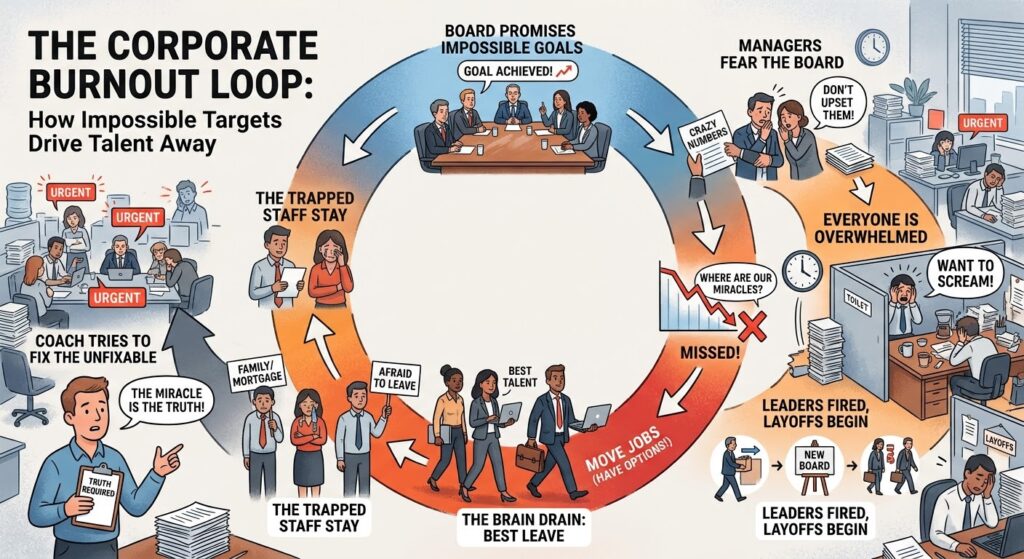
- Step 1: The Board promises a magic target to investors.
- Step 2: Senior VPs panic and pass the crazy numbers downward.
- Step 3: Middle management translates the target into “do or die.”
- Step 4: The shop floor suffers severe burnout, and the exodus begins.
1. The Executive Dilemma
The VPs and Senior Directors receive the news first. They look at the numbers, feel a cold knot form in their stomachs, and realise they’ve been handed a proper dog’s dinner. They have two choices:
- Stand up, present the operational data, and explain why the timeline is impossible.
- Smile, nod, accept the target, and hope a miracle happens before Q4.
In most large enterprises, option one is career suicide. Executives who tell unvarnished truths are swiftly replaced by ambitious “yes-men” who promise the earth with zero intention of sticking around to see it fail. So, the senior leaders swallow their pride, collect their performance bonuses, and kick the can down the road.
2. The Middle Management Pressure Cooker
Next, the targets hit middle management. These are the folks caught in the permanent crossfire between boardroom fantasy and operational reality. They know their teams are already working at 110% capacity. They know that cutting delivery times in half will result in broken code, missed safety checks, or customer service meltdowns.
Do they push back? Rarely. They’ve watched what happens to whistleblowers. Instead, they reframe the impossible target as a “stretch goal” or a “transformational key result,” slap a few motivational quotes onto an internal web page, and dump the pressure straight onto the shop floor.
Act II: The View from the Floor
By the time the new mandates reach the developers, account managers, project leads, and front-line staff, the disconnect between management and reality is total.
The Reality Disconnect
- Boardroom Assumption: “Teams just need extra motivation.”
- Ground-Floor Reality: Teams need a realistic scope and achievable timelines.
- Boardroom Assumption: “New tech tools will double output overnight.”
- Ground-Floor Reality: Legacy systems are crashing under the current load.
- Boardroom Assumption: “Overtime shows passion and commitment.”
- Ground-Floor Reality: Overtime causes heavy fatigue and costly errors.
- Boardroom Assumption: “Silence in meetings means consent.”
- Ground-Floor Reality: Silence means quiet panic and disengagement.
The Bathroom Stall Meltdown
This is the phase where team morale completely collapses. People sit at their desks staring at timelines that defy the basic laws of physics and time.
The immediate human reaction isn’t inspiration; it’s dread. People want to nip off to the loo for a quiet scream just to release the pressure, but they don’t even have time for that—they’ve got 70-hour workweeks to schedule.
To survive, teams adopt a strategy of tactical compliance:
- The Illusion of Speed: Quality is quietly chucked out the window to hit arbitrary milestones.
- Technical Debt: Quick fixes and ugly patches are stacked high, guaranteeing massive system failures six months down the line.
- Emotional Detachment: People stop caring about building great products; they only care about clearing tickets so they don’t get yelled at on Monday morning.
Everyone busts a gut trying to hit goals that were mathematically doomed from day one. Burnout becomes the default operational state, and the workplace transforms into a slow-motion train wreck.
Act III: The Great Talent Drain
When a company builds its business model on delusion, it triggers a quiet sorting mechanism across the entire workforce. The impact is never felt equally—it actively strips the company of its most valuable asset: raw capability.
The Corporate Talent Filter
- High Performers: They have savings, get inundated by recruiters daily, and refuse to play “pretend.” Outcome: They leave immediately.
- Trapped Staff: They face mortgages, family dependencies, or fear of re-entering the job market. Outcome: They stay behind and try to survive the noise.
Why the Best Talent Walks
Your top performers—the people who actually solve the tough problems, write clean code, and keep key accounts happy—are always the first out the door. The reason is dead simple: High performers have options.
When top talent sees leadership trading operational integrity for fantasy metrics, they don’t stick around to be the scapegoats. They update their CVs, drop their resignation letters on the desk, and take a job at a competitor who actually understands how work gets done. They aren’t leaving because they are soft; they are leaving because they refuse to participate in an organized lie.
Who Stays Behind?
As the high performers vanish, the company is left with the people who simply cannot afford to leave. These are folks trapped by heavy mortgages, family dependencies, visa restrictions, or sheer career fatigue.
They aren’t bad workers, but they are terrified. They learn that survival in the company isn’t about solving problems—it’s about keeping your head down, avoiding blame, and looking visibly stressed so management thinks you’re working hard.
The overall skill level of the organisation plummets, cynicism becomes the dominant culture, and hitting future targets becomes even more impossible than it was before.
Act IV: The Crash and the Re-Org Spectacle
Eventually, the calendar runs out. Q4 ends, the smoke clears, and the actual figures are tallied up.
Surprise, surprise: the impossible target was missed by a mile.
The predictable corporate playbook then swings into action:
- Target Missed: The original fantasy figures collapse under reality.
- Investors Furious: Stakeholders demand answers because they were promised a miracle.
- Board Fires Leadership: The C-suite is blamed for “poor execution.”
- New Board Appointed: A fresh team arrives with new shiny promises.
- Rinse and Repeat: The cycle restarts from scratch.
1. The Outrage Phase
The board expresses utter shock and dismay. The investors are furious because they were promised the moon on a stick, and instead, they’ve been handed a loss. Nobody in the boardroom stops to say, “Hang on, were our original expectations completely off the mark?”
Instead, they assume the failure was purely down to poor execution on the floor.
2. The Sacrificial Lambs
Heads must roll to satisfy the market. The CEO is given a generous severance package, a couple of VPs are quietly shown the door, and a press release is issued promising a “renewed focus on execution and accountability.”
3. The Re-Org Circus
A new executive team is brought in. They immediately launch a massive “Transformation Initiative.” They hire expensive management consulting firms who spend three months drawing colorful organizational charts, renaming departments, and introducing brand-new buzzwords.
The existing staff look on with weary eyes. They’ve seen this film before. The boxes on the org chart have moved, but the underlying habit of setting impossible goals remains completely untouched.
Act V: Enter the Miracle Worker
This is the stage where external coaches, agile consultants, or organizational culture experts get called in. The call usually goes something like this:
“Our teams are demotivated, delivery speed is down, and we’ve lost our competitive edge. We need you to come in, do some workshops, and fix our company morale.”
It takes a competent coach about 48 hours on the ground to diagnose the actual problem. You spend ten minutes talking to the floor teams, and you realize they don’t need “agile training,” better project management software, or team-building exercises with trust falls and free pizza.
The Consultant’s Real Diagnosis
- What leadership thinks is wrong: Employees are lazy and lack drive.
- What is actually wrong: Severe, chronic burnout across all departments.
- What leadership thinks is wrong: Processes are outdated or slow.
- What is actually wrong: Commitments were delusional from day one.
- What leadership thinks is wrong: Staff lack motivation and team spirit.
- What is actually wrong: Total lack of psychological safety to speak up.
- What leadership thinks is wrong: The culture needs fixing.
- What is actually wrong: The organization enforces a structural culture of lying.
The teams are demotivated because they are forced to sprint a marathon at maximum speed while wearing a blindfold. They are exhausted from being punished for failing to perform miracles. Trying to “fix morale” without addressing the delusional commitments coming from the top is like trying to put out a forest fire with a water pistol.
How Boards Can Actually Fix the Loop
If you sit on a board, hold executive power, or manage a large organisation, breaking this destructive cycle doesn’t require rocket science. It requires a fundamental shift in how goals are set, communicated, and measured.
1. Validate Before You Commit
Never, under any circumstances, lock in a delivery goal or financial target with investors or shareholders without first conducting a bottom-up reality check with the people who will actually execute it. Top-down vision sets the direction, but bottom-up estimation sets the timeline.
If there is a massive gap between what the market wants and what the operational floor can deliver, your job as a leader is not to pretend the gap doesn’t exist. Your job is to make strategic trade-offs: narrow the scope, increase the budget, or extend the deadline.
2. Make Truth-Telling Safe
If pointing out that a target is impossible gets a manager labeled as “uncooperative,” you are actively building a culture of comfortable lies.
Start actively rewarding people who have the guts to bring bad news early. When an engineer or project manager raises their hand and says, “If we stick to this deadline, the system will crash under heavy load,” do not reprimand them. Thank them publicly. They just saved your company millions of pounds and protected your brand’s reputation.
3. Respect the Laws of Capacity
You cannot negotiate with capacity. If your engineering or operational capacity is 1,000 hours a month, dumping 1,800 hours of work onto the schedule will not magically create 800 extra hours of output. It will simply create:
- 400 hours of rushed, low-quality work filled with critical errors.
- 400 hours of pure burnout, sick leave, and chaotic context switching.
- A stack of resignation letters from your best staff.
Measure real capacity based on historical data, not hope. Work with reality, not against it.
4. Kill the “Can-Do” Toxic Positivity
There is a massive difference between high ambition and institutional delusion. Ambition inspires people to solve hard problems; delusion asks people to pretend problems don’t exist.
Replace toxic “yes-man” positivity with pragmatic, ground-level engineering logic:
- Ask: “What would it take to hit this date?”
- Listen to the cost: “It will require doubling the team, cutting features A and B, and accepting higher risk.”
- Decide: “Are we willing to pay that cost?”
If the answer to the cost is “no,” then the answer to the target date is also “no.”
The Value of Unvarnished Truth
Building a sustainable, high-performing corporate culture isn’t about making everyone feel happy with platitudes and ping-pong tables. It’s about respecting your people enough to tell them the truth, and building an environment where they have the guts to tell you the truth right back.
A company where an entry-level worker can look a Vice President in the eye and say, “That target is impossible, and here is the data why,” is an organisation that will survive, adapt, and win.
When you align your business targets with operational reality, something remarkable happens: the toxic pressure drops, your top performers stay because they feel respected and heard, the quality of execution skyrockets, and for the first time in years, you actually start hitting your numbers.
FURTHER READING