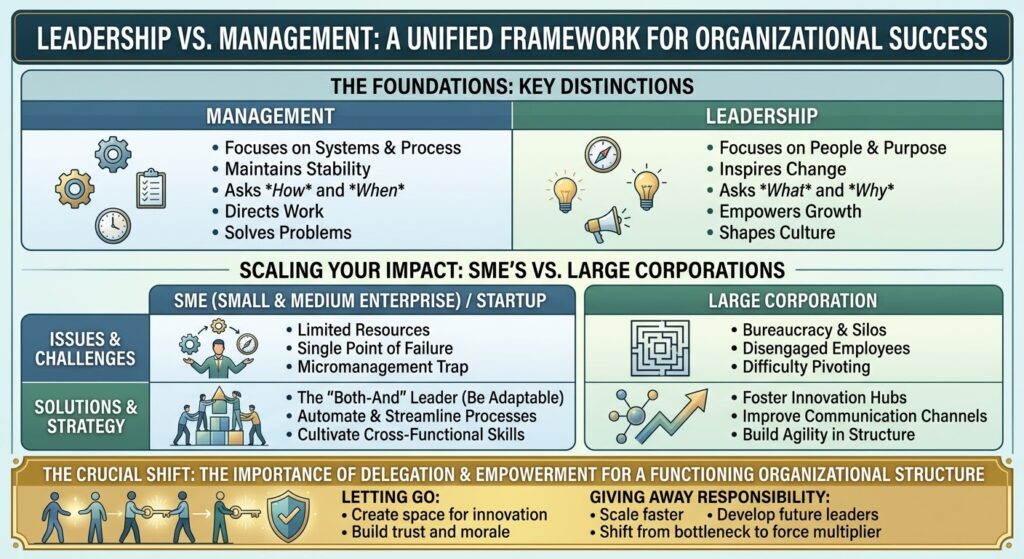
We love to treat “Leadership” and “Management” as opposing corporate camps, locked in an endless battle of philosophy over coffee breaks.
On one side, you have the visionary Leader, staring heroically out of a floor-to-ceiling window, pondering the grand future of humanity while holding an artisanal oat milk latte. On the other, you have the sensible Manager, armed with color-coded spreadsheets, enforcing budget compliance and gently reminding everyone that expenses must be filed by 5:00 PM on Friday or humanity’s future will have to wait.
It’s a nice narrative. Then again, in the real world, treating these two roles as completely separate species is precisely why so many businesses run out of steam—and why so many managers look like they haven’t slept since 2019.
If you want an organization that actually functions—rather than one that merely survives from one existential crisis to the next—you need to understand how leadership and management intersect, how company size changes the rules, and why your inability to hand over control might be the biggest bottleneck in the room.
1. The Core Distinctions: A Quick Refresh
Let’s keep it delightfully simple. Management and leadership are not different ranks on an org chart; they are two entirely different mindsets that just happen to share the same office kettle.
– Management is about systems and execution. It keeps the ship upright, ensures the engine is oiled, and deals strictly in the realm of How and When. It values stability, predictability, and efficiency—the administrative equivalent of a sturdy pair of orthopedic shoes.
– Leadership is about people and purpose. It decides where the ship is sailing, navigates uncharted waters, and deals in the realm of What and Why. It values vision, inspiration, and intentional change—basically the shiny, expensive sports car of workplace attributes.
An organization with pure management and no leadership becomes remarkably efficient at walking straight off a cliff in perfect formation. Conversely, an organization with grand leadership and zero management is just a group of deeply passionate dreamers missing every single deadline while running out of money in record time.
You need both. But how you balance them depends entirely on whether your company operates out of a converted garage or a twenty-story glass tower with fancy security badges.
2. The SME Dilemma: Wearing Two Hats Without Losing Your Mind
If you run or work in a Small or Medium Enterprise (SME), the luxury of leaning back in your chair and declaring “I’m purely a visionary, I don’t do logistics” is a fantasy reserved for billionaires and film characters.
In a smaller firm, you don’t get the luxury of choosing between being a manager or a leader. You are the “Both-And” person, whether you like it or not.
The SME Challenge
The most common trap for small business founders is the Micromanagement Spiral. Because the business started with your blood, sweat, and tears, every decision feels deeply personal. You become the ultimate single point of failure, setting global strategy on Monday morning and personally investigating who stole the printer paper by Tuesday afternoon. You are managing everything, leading nothing, and rapidly approaching a state where screaming into a cushion feels like a valid calendar event.
The SME Solution
– Embrace the Dual Role intentionally: Recognize which “hat” you are wearing in any given conversation. Are you coaching a team member on their long-term growth (Leadership), or establishing a repeatable QA process (Management)?
– Automate and Streamline: Build systems for repetitive operational tasks so your management burden decreases, giving your brain the structural space to actually think.
– Question Your Impulse: Every time you step in to fix a small issue yourself, ask: “Am I solving a temporary problem, or am I creating a permanent bottleneck?”
Balancing both roles in an SME isn’t easy, but at least you’ll never have to ask yourself who to blame when things go wrong—you can just glare at your reflection in the office microwave.
3. Large Corporations: Breaking Out of the Bureaucratic Maze
Step into a multinational enterprise, and the problem flips completely upside down. Here, management and leadership are often so rigidly separated by layers of corporate hierarchy that they might as well be on different continents.
The Corporate Challenge
Large enterprises suffer from silos, inertia, and polite disengagement. Management systems become so thick with bureaucratic red tape that even the most brilliant leadership vision gets stuck in committee review for six months just to agree on the font size. Employees stop asking why they are doing their jobs and settle into doing the bare minimum required to keep their corporate laptops from going into sleep mode.
The Corporate Solution
– Build Agile Innovation Hubs: Give small, cross-functional teams genuine permission to run fast experiments without needing approval from fourteen different steering committees.
– Inject Purpose into Daily Management: Managers in large firms must be empowered to act as local leaders—explaining to their teams how daily operational targets directly feed into the company’s broader mission rather than just keeping executives happy.
Corporate bureaucracy will always try to creep back in, but with a bit of conscious effort, you can ensure your company behaves like an agile speedboat rather than a stranded cruise liner waiting for a tugboat.
4. The Magic Key: Letting Go and Giving Away Power
Whether you are running a ten-person design studio or managing a division of five thousand, there comes a moment when your personal bandwidth hits a hard, uncompromising ceiling.
At this point, business growth is no longer a strategic or operational issue; it’s an ego problem.
To build an organization that truly scales, you must master the terrifying, glorious art of letting go.
Why Giving Away Responsibility Feels Terrifying (And Why You Must Do It Anyway)
Delegation isn’t just about handing someone a list of mundane tasks—that’s just assigning homework and hoping for the best. True delegation means handing over ownership, authority, and the right to make decisions.
A. You Stop Being the Bottleneck: If every operational decision requires your personal rubber stamp, your company’s growth rate is officially capped by your personal calendar and caffeine tolerance. Giving away power frees you up to focus on the moves that actually move the needle.
B. You Build Trust and Morale: Nothing drains talented employees faster than giving them responsibility without authority. When you trust your team with genuine power, they step up, take pride, and occasionally solve problems better than you ever could (which is mildly offensive, but great for business).
C. You Create Future Leaders: You cannot develop strong leaders by keeping them safely tucked behind rigid protocols and sign-offs. They need room to make decisions, execute, and yes—occasionally make mistakes that cause a minor panic before they fix them.
Handing over control might make your palms sweat at first, but remember: if your business can’t survive two weeks without you checking emails on a beach, you haven’t built a company—you’ve just built a very demanding prison.
The Bottom Line
Management keeps the machine running smoothly today; Leadership ensures the machine is actually pointed in a direction worth driving toward tomorrow.
If you feel perpetually overwhelmed, overworked, or trapped in an endless game of corporate fire-fighting, stop asking yourself how to manage your calendar better. Instead, ask a much harder question: What power, authority, or decision am I clinging onto that I need to hand over to someone else today?
Accept that things might look a little different when you let go—then again, having a functional business and getting your evenings back might just be worth the shock.
Struggling to balance management, leadership, or team dynamics in your organization?
At Then-Again, we help business leaders cut through the organizational noise, resolve internal friction, and build frameworks for sustainable growth. Book a session with us today to stop being the bottleneck in your own success story.
Further reading:
https://cerj.educ.cam.ac.uk/archive/v62019/CORERJ-Journal-Volume6-12-BecomingALeader.pdf
https://hbr.org/2001/12/what-leaders-really-do
https://hbr.org/1999/11/management-time-whos-got-the-monkey